Self Storage Payment Processing: The Autopay Nobody Audits
In Self Storage, Every Tenant Is on Autopay: And That’s Where the Money Leaks
Self storage is one of the only businesses where nearly every customer is on autopay from day one. A tenant signs a month-to-month lease, puts a card on file, and then disappears — the rent just runs every month, untouched and unexamined, sometimes for years. That is a beautiful thing operationally. It is also exactly why self storage payment processing quietly costs more than it should: when every dollar is recurring and nobody ever looks at the charge, a markup buried in a flat rate runs forever and nobody catches it.
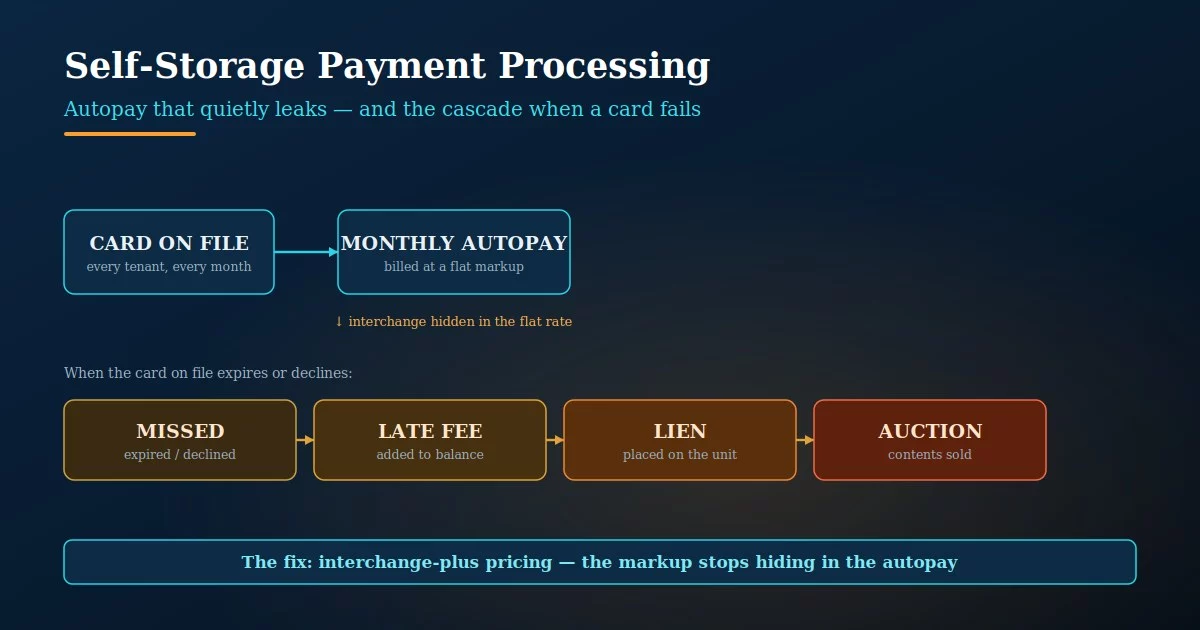
There are two places a storage operator loses money on payments, and neither one shows up as a line item you’d notice. The first is the markup hiding inside that monthly autopay. The second is what happens when a card on file quietly fails — because in self storage, a declined card is not a missed payment, it’s the first step in a cascade that ends at a lien and an auction.
A Flat Rate on 100% Recurring Volume Is Where It Hurts Most
Most storage operators are sold a flat rate — one simple percentage on every charge — because it sounds clean and predictable. On a business with occasional, varied transactions, the damage from that simplicity is limited. On a storage facility, where the entire revenue book is the same few hundred autopay charges repeating every single month, a flat rate is the worst possible structure, because the markup compounds across every unit, every month, with no offsetting low-cost transactions to dilute it.
Here is the mechanic. Your true cost on a card is interchange (set by the networks) plus a small processor margin. A flat rate bundles those together and adds a cushion on top, then charges that blended number on everything — including the regulated debit cards and basic consumer cards that actually cost very little to run. On a storage book that skews toward routine monthly rent, you are paying premium-card pricing on a lot of cheap-card volume. Across a 400-unit facility billing twelve times a year, that spread is thousands of dollars a year that never had to leave the building.
A flat rate looks like one number, but it is really the network’s cost plus a hidden margin. On varied retail sales that margin gets averaged out. On a storage facility’s nearly identical, endlessly repeating autopay charges, there is nothing to average it against — so the same overcharge lands on every unit, every month, for the life of the tenancy. The more stable your occupancy, the more a flat rate quietly costs you.
A Declined Card Isn’t a Missed Payment: It’s the Start of a Lien
In most businesses, a failed card is a quick annoyance: you ask the customer for another one and move on. In self storage, the customer is gone. They set autopay precisely so they’d never have to think about the unit again, which means when their card expires or is reissued after a fraud alert, nobody notices until the charge silently fails — and the tenant never sees a problem, because they’re not looking.
From there the cascade is mechanical and expensive. A missed charge becomes a late fee. The late fee compounds. Eventually the unit goes to lien, and in many states the contents head to auction — a process that costs you staff time, legal exposure, and the rent you never collected, all to recover a unit that was paying perfectly until a card number changed. This is involuntary churn, and in self storage payment processing it is one of the largest hidden sources of lost revenue. The fix is unglamorous and effective: an account updater service that automatically refreshes expired and reissued card numbers with the networks before the charge fails, plus a dunning sequence that actually reaches the tenant when an update isn’t available.
A unit lost to a failed card looks exactly like a unit lost to a move-out on your books, but it’s worse — the tenant didn’t want to leave, and you spent staff hours and lien costs to lose them. Visa and Mastercard account updater services catch most expired and reissued cards automatically. If your processor isn’t running one on your card-on-file base, that’s the first leak to close.
Your Long-Term Tenants Don’t Need to Be on a Card at All
A meaningful share of a storage facility’s revenue comes from tenants who have been there for years and will be there for years more. Running that stable base on credit cards every month means paying card economics on revenue that has no reason to touch the card rails. For long-term, predictable rent, bank-account autopay over ACH costs a flat few cents per transaction instead of a percentage — and on a large recurring book, moving even part of your tenants to ACH is one of the cleanest cost reductions available to a storage facility payment processing setup.
Cards still matter for move-ins, short-term tenants, and the convenience tenants expect, so self storage credit card processing isn’t going anywhere. The point is that a well-built self storage merchant account offers both, and routes each tenant to the cheaper rail where it makes sense, rather than forcing the entire book onto one expensive default.
Offer ACH bank autopay alongside cards and nudge your long-tenure tenants toward it. On the stable core of your rent roll, the per-transaction savings versus card pricing add up every month — and unlike a card, a bank account doesn’t expire and trigger the lien cascade.
What Self Storage Payment Processing Should Actually Look Like
Put the pieces together and a strong self storage payment processing setup is straightforward. Price the card volume on interchange-plus so the network cost and the processor margin are visible and the markup stops hiding in a flat rate. Run an account updater on the entire card-on-file base so reissued cards don’t quietly trigger liens. Offer ACH for the long-term tenants who don’t need to be on a card. And know your real number — your blended effective rate across every charge — because on a 100% recurring book, a half-percent of hidden markup is a number worth chasing.
None of this changes how your tenants pay or how your gate and software work. It changes what you keep. For a storage operator running hundreds of identical autopay charges a month, the difference between a flat rate and a transparent one isn’t rounding — it’s real money, every month, for as long as the units stay full.
Be most skeptical of the word “simple.” A flat, all-in rate is pitched as the easy choice, and on a storage facility’s wall-to-wall recurring volume it is precisely the structure that costs you the most. Simple for the processor to bill is not the same as cheap for you to pay. On a recurring book this large, ask for interchange-plus and the line-item detail behind it.
Frequently Asked Questions
Interchange-plus pricing on the card volume so the markup is visible, an account updater running on your entire card-on-file base to stop reissued cards from triggering liens, and an ACH bank-autopay option for long-term tenants. That combination handles both leaks unique to storage: the flat-rate markup and involuntary churn.
Because tenants set autopay to forget the unit, so when a card expires or is reissued after fraud, nobody notices until the charge declines. An account updater service refreshes those card numbers with Visa and Mastercard automatically, catching most failures before they start the late-fee-to-lien cascade.
Both. Cards for move-ins, short-term tenants, and convenience; ACH bank autopay for the long-term base, where the flat per-transaction cost beats card pricing and the account never expires. Routing each tenant to the cheaper rail is the point of a well-built self storage merchant account.
See What Your Recurring Rent Is Really Costing You
Send Brookside one recent statement and we’ll calculate your true effective rate across your autopay book, show you where a flat rate is overcharging the recurring volume, and flag whether an account updater is catching your reissued cards. No switch required to find out. Learn more about payment processing consumer protections from the CFPB.
Get Your Storage Rate ReviewedNo obligation • No pressure • Response within one business day
See what a statement review looks like →