Bakery Payment Processing: The Dime That Eats Your Morning Rush
The Fee That Hides in a $6 Ticket
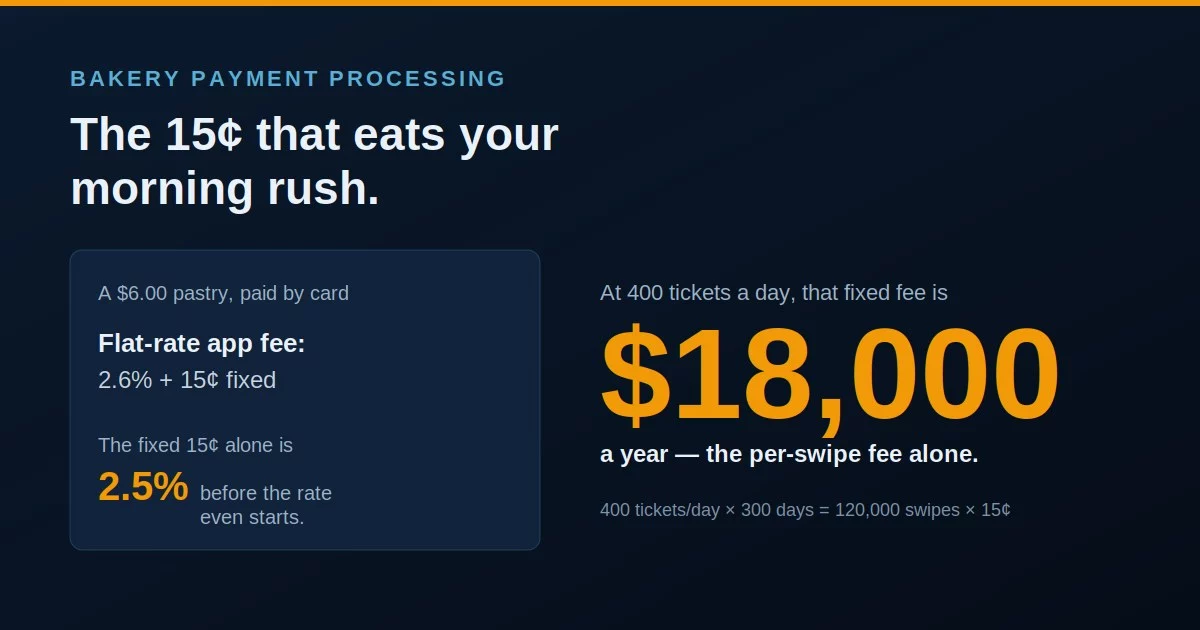
Bakery payment processing looks cheap right up until you do the math on a single croissant. The rate on your statement isn’t the number that hurts you — the fixed fee stapled to every swipe is. A bakery runs on hundreds of small tickets a day, and every one of them pays that flat fee whether the sale is $4 or $40.
That is the quiet difference between bakery payment processing and, say, a furniture store. The furniture store spreads one fee across a $2,000 sale. You spread the same fee across a $6 pastry. Same fee, wildly different bite. Understand that one mechanic and the whole pricing conversation changes.
Why the Fixed Fee Punishes Small Tickets
Most card pricing has two parts: a percentage of the sale and a fixed amount charged on every transaction. On a large ticket the fixed part disappears into the rounding. On a bakery ticket it becomes the whole story, because a flat 15¢ is a much bigger share of a small number than a large one.
- $6 pastry: 16¢ + 15¢ = 31¢ → a 5.1% effective rate
- $60 order: $1.56 + 15¢ = $1.71 → a 2.9% effective rate
- Same rate quoted on both. The ticket size did the damage.
Nobody quotes you “4.3%.” They quote the 2.6% and let the fixed 15¢ do its work in the background. On a shop turning 300 to 500 tickets a day, that fixed fee is the line item worth chasing in your bakery payment processing — not the headline rate you were sold on.
Flat-Rate Apps vs. What a Bakery Actually Needs
Flat-rate systems — Square, Toast, Clover in flat mode — win on setup. You unbox the reader, you take a card, you are running before the pastries cool. For a brand-new bakery doing a few dozen sales a day, that simplicity is worth something.
The problem is that flat-rate keeps charging the same blended number as your volume grows, and a bakery’s volume is made of exactly the small, high-count tickets a blended rate treats worst. Interchange-plus pricing does the opposite: it charges the true cost of each card plus one fixed markup you can actually see, and it saves the most on precisely the low-ticket, high-frequency pattern a bakery lives on. That is the whole case for interchange-plus in bakery payment processing.
A shop running $45,000 a month across small tickets often sees an effective rate near 4% to 4.5% on a flat-rate app once the 15¢ is spread over small sales. Moved to interchange-plus with debit routing, that same volume typically lands closer to 2.9% to 3.2% — several hundred dollars a month that was going to the per-swipe markup instead of your ovens.
You Can’t Surcharge a $5 Croissant
The advice a bakery usually hears first is “pass the fee to customers.” At a counter moving fast on small tickets, that lands badly. A surcharge line on a $5 sale reads as nickel-and-diming, a cash-discount sign confuses the morning rush, and neither move fixes the underlying cost — it just relocates it onto the customer you want back tomorrow.
The lever that actually moves bakery payment processing costs sits on the pricing side, not the customer side. Interchange-plus strips the padded markup. Debit routing sends debit cards — a big share of small local purchases — over the cheapest network instead of the default one, which on high-count small tickets is real money.
Surcharging is legal in most states but carries disclosure and card-network rules, and it can only be applied to credit, never debit. On a bakery’s debit-heavy, low-ticket mix, the compliance overhead usually outweighs what you would recover. Fix the rate first; revisit passing fees only on larger custom orders.
Wholesale, Custom Orders, and Tips
A retail bakery is rarely just a retail bakery. The moment you sell wholesale — trays to a cafe, bread to a restaurant, boxes to a grocer — you are running B2B transactions that behave nothing like the counter. Those are larger, invoiced, and often card-avoidant, which is where a proper wholesale payment processing setup earns its keep with Level 2 data and ACH bank transfers that dodge card fees on big recurring orders.
Custom-cake and catering work adds a third flow: a stored card, a deposit up front, and the balance on pickup. A single bakery merchant account can carry all three — fast counter sales, invoiced wholesale, and deposit-based custom orders — where a flat-rate app usually handles only the first. That breadth is the difference between bakery credit card processing that fits the business and a tool that fits only the register.
Then there are tips. If your counter runs a tip screen, the prompt design changes what customers actually leave — and the wrong default can quietly annoy the regulars you depend on. That is worth getting right on its own; see our guide to tip screen best practices.
How to Fix Bakery Payment Processing
You do not need to rip out your point of sale to fix the fees. Bakery payment processing improves in a fixed order, and the first step costs nothing but a statement.
- Pull one recent statement and find your real effective rate — total fees divided by total volume, not the quoted rate.
- Move to interchange-plus so the markup is one visible number instead of a blended guess.
- Turn on debit routing to cut the cost of your debit-heavy small-ticket mix.
- Match the hardware to your counter speed — you keep the workflow, you change the cost underneath it.
- Split wholesale onto Level 2 or ACH so big invoices stop paying retail card rates.
Done in that order, a bakery merchant account that was quietly running past 4% often comes down near 3% without changing a single price on the menu board.
Frequently Asked Questions
Not bad, just expensive at volume. Flat-rate charges a blended fee that hits small, high-count tickets hardest — exactly a bakery’s pattern. It is fine at a few dozen sales a day; past that, interchange-plus almost always costs less.
Judge the effective rate, not the quote. A small-ticket bakery on interchange-plus with debit routing typically lands around 2.9% to 3.2% all-in. If your statement shows 4% or more, the per-swipe markup is the reason.
You can surcharge credit cards where it is legal, but not debit, and the disclosure rules rarely pay off on tiny debit-heavy tickets. Fixing the underlying rate saves more than surcharging a $5 sale ever will.
Send One Statement. We’ll Find the Leak.
If your bakery runs hundreds of small tickets a day, the per-swipe fee is where the money leaks. Send Brookside one recent statement and we’ll calculate your true effective rate and show you exactly what interchange-plus and debit routing would save — the math takes us about fifteen minutes. Learn more about payment processing consumer protections from the CFPB.
Send Your Statement for a Free ReviewNo obligation • No pressure • Response within one business day
See what a statement review looks like →