Interchange Has a Schedule. Your Processor Hopes You Don’t Know It.
Interchange Has a Schedule. Your Processor Hopes You Don’t Know It.
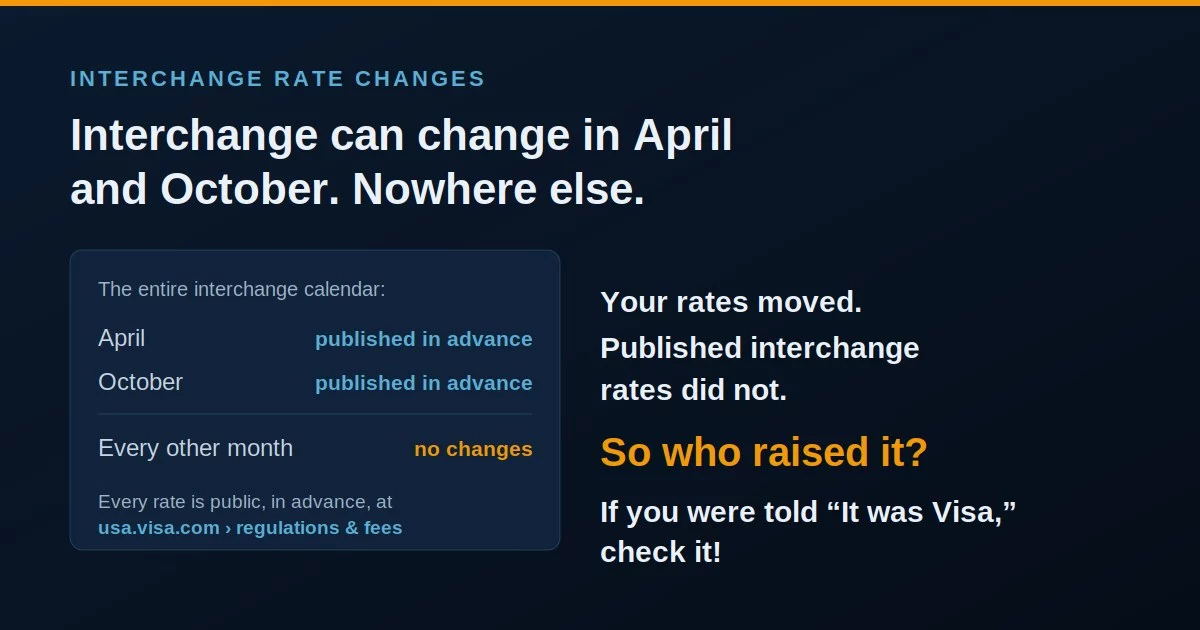
Interchange rate changes are not a mystery, a surprise, or a moving target. Visa and Mastercard update their interchange tables on a published schedule, twice a year: April and October. That’s the whole calendar.
Which means the single most useful thing a merchant can know about their processing bill is this: if your rate went up in July, it wasn’t interchange. Nothing changed in July. Somebody raised your price and pointed at Visa, because pointing at Visa ends the conversation.
What Actually Happens, and When
Interchange rate changes are published openly by both card brands. This isn’t insider information — it’s a PDF on their website that almost no merchant has ever opened.
- April — rates published in advance, effective mid-month.
- October — same.
- Every other month — nothing. No changes. None.
- You can read the current tables yourself: Visa publishes its interchange rates here.
That’s the entire mechanism. Two updates a year, published ahead of time, applying to everyone. There is no secret mid-year interchange adjustment that your processor found out about and you didn’t.
Real Interchange Changes Look Different From a Markup Grab
Even inside April and October, genuine interchange rate changes don’t behave the way a processor increase does. Learning the difference takes about two minutes and it is worth thousands.
- Interchange changes are surgical. They move specific card categories by a few basis points — a rewards tier here, a category there. Your effective rate barely twitches.
- Markup increases are blunt. Every transaction costs more. Your effective rate jumps across the board, on every card type, all at once.
- Interchange changes hit everyone. Markup increases hit you.
So when a statement shows an effective rate that jumped forty basis points overnight — on every card, in a month that isn’t April or October — that is not interchange. That is a repricing, and it has a person’s name on it. We’ve written about what to do when your processor blames Visa, but this is how you know before you pick up the phone.
Most Interchange Rate Changes Won’t Touch You
The other thing nobody explains: an April or October update is not a blanket increase. The card brands adjust categories — a rewards tier, a specific merchant classification, a card-not-present bracket — and most merchants are only exposed to a handful of them.
So a real update might raise the cost of premium rewards credit cards by a few basis points while leaving regulated debit untouched. If your business runs heavily on debit, that change costs you almost nothing. If you take a lot of premium rewards cards, you’ll feel it — and the honest way for a processor to explain that is to name the category and the number.
"Visa raised the CPS Retail rewards category by four basis points in the April release, which affects about 30% of your volume, so your cost went up roughly one and a half basis points overall." That’s a processor telling you the truth. "Visa raised rates" is not an explanation — it’s the end of one.
The Contract Term That Makes This Legal
Here’s the uncomfortable part. Most processing agreements contain a clause allowing the processor to pass through "increases in interchange, assessments, or network costs." Fair enough — those are real pass-through costs.
But the same clause is usually written loosely enough to cover the processor’s own increases too, with thirty days’ notice buried in a statement message nobody reads. The interchange rate changes calendar is what strips the cover off: the clause lets them pass through Visa’s increases, and Visa didn’t increase anything in July.
How to Audit an Interchange Increase
When your rate moves and interchange rate changes are blamed, you don’t have to accept the explanation. You can check it, in this order.
- Check the month. Not April or October? Then interchange rate changes had nothing to do with it. Stop there; you already have your answer.
- Compare effective rates, not headline rates. Total fees divided by total volume, this month against last. That’s the number that reveals a repricing.
- Look at the spread, not the total. If interchange rose and your markup held steady, that’s honest. If your markup grew, that’s a price increase wearing a costume.
- Ask them which specific interchange category changed, and by how many basis points. An honest processor answers in one sentence. A dishonest one changes the subject.
That last question is the whole test, and it’s why interchange-plus pricing matters so much: it separates the pass-through cost from the markup on the statement itself, so a repricing has nowhere to hide. On tiered pricing, the two are blended into one number and you can’t audit anything. If you want the actual numbers your category runs at, the interchange rates by industry reference lists them straight from the current schedules — including the lower small business interchange rates Visa publishes for merchants under $280,000 a year.
Frequently Asked Questions
Visa and Mastercard update interchange twice a year, in April and October, and publish the tables in advance. No changes occur in any other month. A rate increase outside those windows did not come from the card brands.
First, check the month — if it isn’t April or October, the answer is no. Then ask which specific interchange category moved and by how many basis points. The tables are public, so the claim is verifiable. An honest processor will answer directly.
Most agreements allow price changes with notice — often a line buried in a statement message. That’s why the calendar matters: it distinguishes a genuine pass-through of interchange rate changes from a markup increase using Visa as cover.
Send One Statement. We’ll Tell You Who Raised It.
If your effective rate jumped and you were told it was the card brands, that claim is checkable — and often wrong. Send Brookside one recent statement and we’ll separate the real interchange from the markup, and tell you exactly which one moved. About fifteen minutes, and we’ll give you the answer either way. Learn more about payment processing consumer protections from the CFPB.
Send Your Statement for a Free ReviewNo obligation • No pressure • Response within one business day
See what a statement review looks like →