Your Software Publishes Its Rate. Visa Publishes Theirs. Here’s the Gap.
Software Payment Processing Fees Are Published. So Is Interchange. Nobody Puts Them Side By Side.
Software payment processing fees are not a secret. Jobber publishes its rate. So do Mindbody, Vagaro, Dentrix, ServiceTitan, QuickBooks and every other platform that bundles payments into the software you already run your business on. You can find the number on their pricing page in about thirty seconds.
The card networks publish their numbers too, and that is the second half of the software payment processing fees question. Visa and Mastercard put out a full interchange schedule twice a year — April and October — and it is a free PDF on their own websites. Interchange is the wholesale cost of a card transaction: the part that goes to the bank that issued your customer’s card. It is not negotiable, and no processor on earth pays less than it.
Both numbers are public. Both have been public for years. And as far as we can tell, nobody has ever put them in the same table.
So we did. The gap between what your software charges you to process a payment and what the networks charge to move it is the subject of this entire article, and for some industries it is not a spread. It is the whole fee.
Software Payment Processing Fees vs Published Interchange
Every rate in the left column is the platform’s own published price, documented in the Brookside post linked beneath it. Every rate in the interchange column comes from the Visa schedule effective 2026-04-18 and the Mastercard schedule effective 2026-04-17. Nothing here is estimated.
| Industry & software | Typical ticket | Software all-in | Published interchange | Gap |
|---|---|---|---|---|
| Property management AppFolio-class · 2.9% + $0.30 | $1,800 | 2.92% | flat $0.75 0% | —2.88 pts |
| Utility / municipal billing portal-bundled · 2.9% + $0.30 | $150 | 3.10% | flat $0.75 0% | —2.60 pts |
| HOA / community association software-bundled · 2.6% + $0.10 | $400 | 2.62% | flat $0.75 0% | —2.44 pts |
| Fitness / wellness studio Mindbody · 3.6% + $0.30 | $120 | 3.85% | 1.15–2.40% + $0.10 | 1.37 pts |
| Salon / spa Vagaro · 3.5% + $0.15 | $85 | 3.68% | 1.15–2.30% + $0.10 | 1.26 pts |
| Dental Eaglesoft · 3.5% + $0.15 | $450 | 3.53% | 1.43–2.30% + $0.05 | 1.22 pts |
| Dental Dentrix Pay · 3.2% + $0.15 | $450 | 3.23% | 1.43–2.30% + $0.05 | 0.92 pts |
| Chiropractic ChiroTouch · 2.99% + $0.15 | $110 | 3.13% | 1.43–2.30% + $0.05 | 0.78 pts |
| Restaurant flat-rate POS · 2.9% + $0.30 | $45 | 3.57% | 1.85–2.60% + $0.10 | 0.74 pts |
| Trades / field service Jobber → Stripe · 2.9% + $0.30 | $450 | 2.97% | 1.15–2.30% + $0.10 | 0.64 pts |
| Auto repair Tekmetric · 2.9% + $0.25 | $550 | 2.95% | 1.15–2.30% + $0.10 | 0.63 pts |
| HVAC / plumbing ServiceTitan · 2.9% + $0.30 | $900 | 2.93% | 1.15–2.30% + $0.10 | 0.62 pts |
| Retail POS Lightspeed · 2.6% + $0.30 | $70 | 3.03% | 1.51–2.30% + $0.10 | 0.59 pts |
| Accounting / bookkeeping Xero · 2.9% + $0.30 | $600 | 2.95% | 1.15–2.40% + $0.10 | 0.53 pts |
| Small business invoicing QuickBooks · 2.9% + $0.25 | $500 | 2.95% | 1.15–2.40% + $0.10 | 0.53 pts |
A fixed per-transaction fee is a percentage in disguise, and the ticket size decides how big a percentage it is. Every row above states the ticket it was calculated at. Change the ticket and the gap changes. That is not a weakness in the table — it is the single most important thing it has to teach you, and it is why the bottom of this table matters as much as the top.
The interchange column also uses the top of each published band, not the middle. The band is wide because it spans card tiers, and your customer picks the card, not you. Measuring against the top means every gap above survives even if every single customer paid you with a premium rewards card. The real gap is wider than what you see.
For Utilities, HOAs and Property Managers, the Software Payment Processing Fees Have Almost Nothing Underneath Them
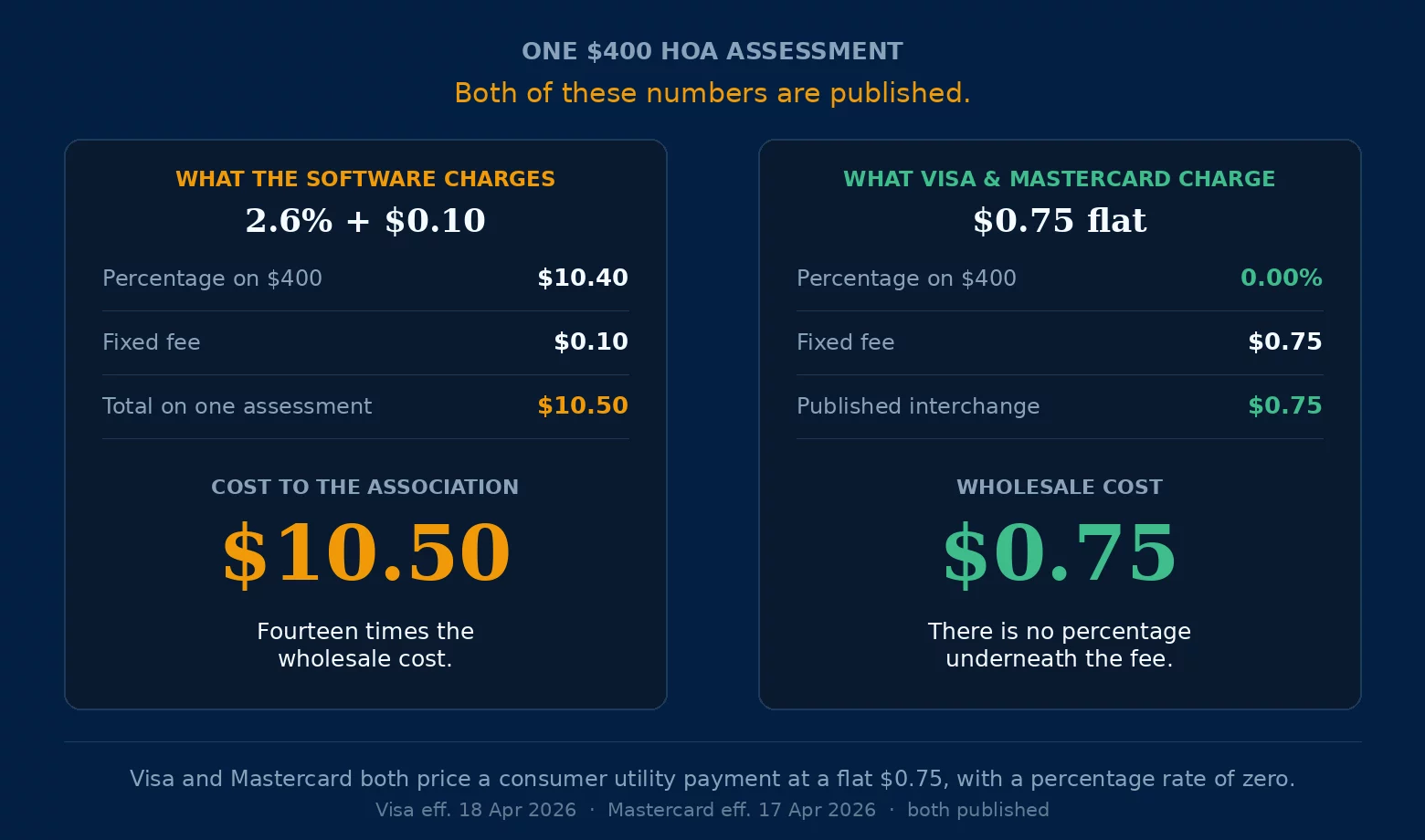
Look at the top three rows. They are not the biggest markups because someone is being greedy. They are the biggest because Visa and Mastercard both price a consumer utility payment at a flat $0.75, with a percentage rate of zero.
Read that again, because it is the whole point. Not a low percentage. No percentage. The networks charge a fixed 75 cents to move a utility payment, whether the payment is $40 or $4,000.
So when an association management platform bills a $400 HOA assessment at 2.6% + $0.10, the association pays $10.50 on a transaction where the network charges 75 cents. That is not a marked-up cost. It is a fee with almost nothing underneath it — the software payment processing fees are the product, not the pass-through.
This is why HOA fee collection, property management and utility billing are the three widest gaps in the table, and it is why an ACH-first strategy pays for itself so quickly in those verticals.
In Professional Services, Software Payment Processing Fees Are Flat — and So Is the Floor Beneath Them
Here is a fact almost no merchant knows. Mastercard’s Service Industries interchange program is 1.15% + $0.05 — and it is identical across every single card tier, from a basic Core card to a World Elite.
In most industries, that is not how it works. A customer paying with a premium rewards card costs the merchant substantially more than one paying with a basic card, and the merchant has no say in which card gets handed over. In professional services, that variable disappears. The floor is low and it is stable.
Meanwhile the platforms serving those merchants — Jobber, ServiceTitan, Xero, QuickBooks — bundle payments at 2.9% + $0.25–$0.30 and do not vary it either. The gap is not dramatic on any one job. It is simply there on every job, forever, and it is the widest repeatable gap in the table: law firms, accountants, HVAC, plumbing, electrical, auto repair.
If You Run a Coffee Shop, This Table Is Not Your Problem
Restaurant and retail sit at the bottom of the ranking, and we are not going to pretend otherwise to sell you something. For a small-ticket business, software payment processing fees are simply not where the money is going.
On a $45 restaurant ticket, the whole conversation is dominated by fixed per-transaction fees, and the percentage barely moves the needle. On a $4 coffee, a 30-cent fixed fee is 7.5% before any percentage rate is applied at all — and no pricing model makes that arithmetic go away. Below roughly $10,000 a month in card volume, a real merchant account usually costs a small merchant more than a flat-rate app, because PCI, gateway and monthly minimum charges do not scale down.
If that describes you, the honest answer is to stay where you are. We would rather tell you that than sign you.
Software Payment Processing Fees Are Only Part of It — the Real Gap Is Bigger, in Three Ways
Everything above is built from two published sources. Which means it is missing everything that only shows up on an actual statement — and every one of those omissions pushes the number the same direction.
Which is the honest summary of this whole exercise: the table understates the problem, and it still looks like that. Run your own numbers — the calculator now shows the published interchange floor for your industry and measures your real rate against it.
Frequently Asked Questions
Neither, exactly. Your software is charging a price it publishes openly, and it is entitled to. What the table shows is the distance between that price and the wholesale cost underneath it — and that distance is the part nobody puts in front of you. Whether it is worth paying is a decision you can only make once you can see it.
Usually not. Most platforms in the table either let you connect an outside processor or run on a gateway that does. The software keeps doing the scheduling, the invoicing and the records; only the payment rail underneath it changes. Where a platform genuinely locks you in, we say so in that platform’s own post.
Because interchange is not a rate anyone offers you — it is the wholesale cost the processor pays, before assessments and before their own margin. Nobody sells at interchange. But it is the floor, it is published, and knowing where the floor sits is the difference between negotiating and guessing.
Find out where your business actually sits.
Your software payment processing fees are a published number. What you actually pay is not. Send one processing statement and we will calculate your true effective rate, show you which line items are interchange and assessments (pass-through, and nobody can discount them) and which are markup, and tell you what the same volume would cost under interchange-plus — in writing, with the dollar difference. If your pricing is already competitive, we say so and you owe nothing. Card fee rules and consumer protections are covered by the CFPB.
Get Your Free Statement ReviewNo obligation • No pressure • Response within one business day
See what a statement review looks like →